reason for your answer.
Here is the step by step explanation to the A.P problem,
For more math help,You can refer the below links which are very helpful,
www.tutorvista.com ,tutor.com, other links

Euclid’s five postulates
Postulate 1 : A straight line may be drawn from any one point to any other point.
Axiom 5.1 : Given two distinct points, there is a unique line that passes through
them.
How many lines passing through P also pass through Q (see Fig. 5.4)? Only one,
that is, the line PQ. How many lines passing through Q also pass through P? Only one,
that is, the line PQ. Thus, the statement above is self-evident, and so is taken as an
axiom.
Postulate 2 : A terminated line can be produced indefinitely.
Note that what we call a line segment now-a-days is what
line. So, according to the present day terms, the second postulate says that a line
segment can be extended on either side to form a line (see Fig. 5.5).
Postulate 3 : A circle can be drawn with any centre and any radius.
Postulate 4 : All right angles are equal to one another.
Postulate 5 : If a straight line falling on two straight lines makes the interior
angles on the same side of it taken together less than two right angles, then the
two straight lines, if produced indefinitely, meet on that side on which the sum of
angles is less than two right angles.
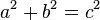
In any right triangle, the area of the square whose side is the hypotenuse (the side opposite the right angle) is equal to the sum of the areas of the squares whose sides are the two legs (the two sides that meet at a right angle).The theorem can be written as an equation:

Use Pythagoras theorem to evaluate the length of PR. PR=√122+202 adjacent Cosθ= ---------- hypotenuse RQ = ---- PR 12 = ----- √544 = 0.514 is the AnswerFor more help on this ,you can reply me.